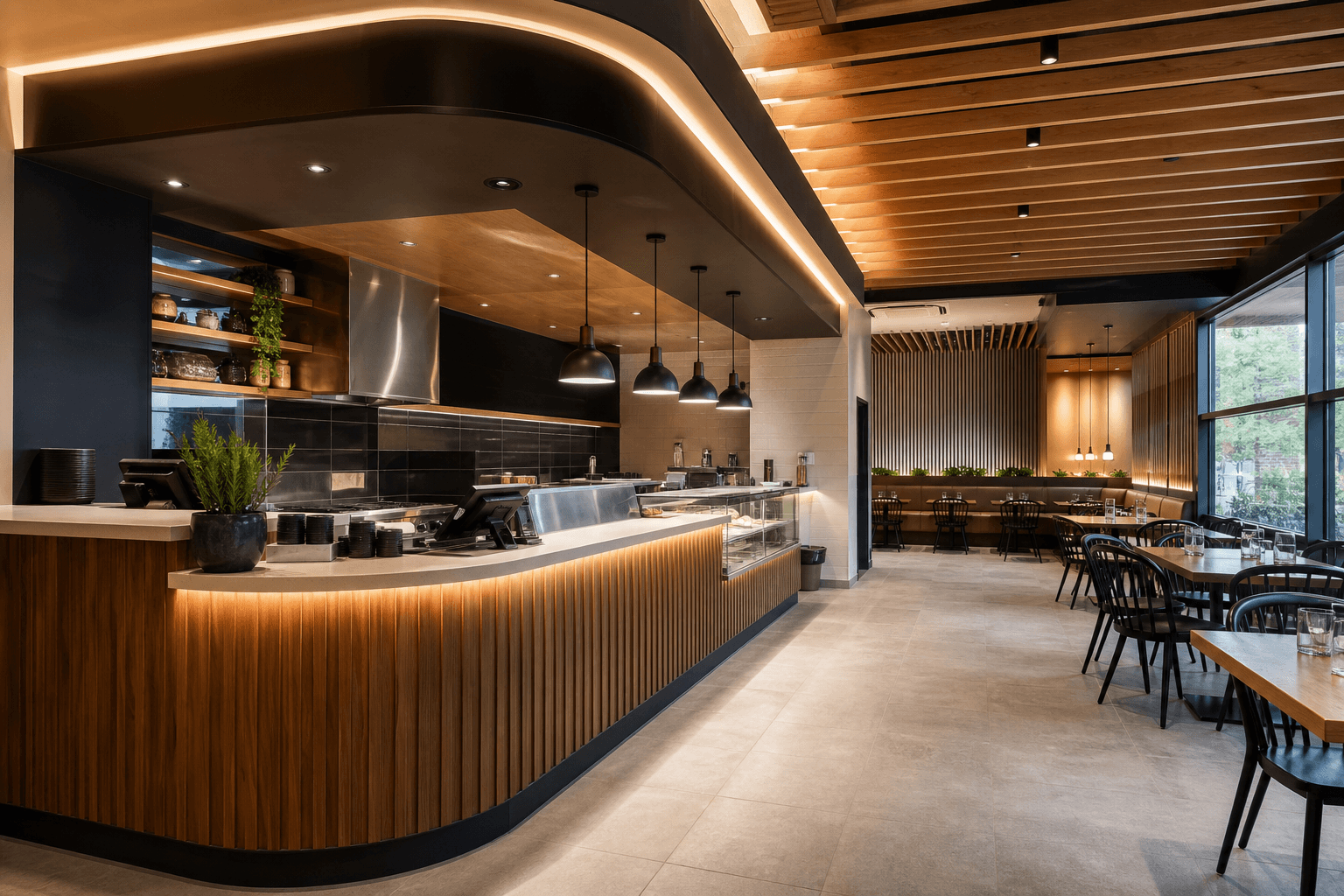
To compare a commercial construction company in Ontario, look beyond the headline price. Assess whether each contractor has relevant project experience, understands your complete scope, can coordinate the required trades, explains its estimate clearly, and provides evidence of comparable finished work. The strongest choice is the contractor whose documented capabilities fit your project, location, finish expectations, and operating requirements.
The comparison framework at a glance
Assess every commercial contractor against the same eight criteria:
- Relevant experience with your project type
- Full-scope capability
- Trade coordination
- Code-conscious planning
- Portfolio evidence
- Estimate clarity
- Communication
- Ontario and GTA service-area fit
These criteria are not a universal ranking system. They help reveal gaps. A contractor may be well suited to a restaurant build-out but less suited to an institutional renovation, so judge the fit against the work you actually need.
Commercial contractor comparison table

| Criterion | Questions to ask | Evidence to request | Why it matters |
|---|---|---|---|
| Relevant experience | Have you completed projects like this one? | Comparable project categories and examples | Different spaces have different operational and finish requirements. |
| Full-scope capability | Which parts of the project will you manage? | A breakdown covering construction, millwork, lighting, counters, and finishes | Clear boundaries prevent important work from being overlooked. |
| Trade coordination | Who sequences the work and resolves conflicts? | Named responsibilities and planning approach | Multiple trades need a coordinated path through the project. |
| Code-conscious planning | How will project requirements be reviewed? | Written assumptions and required design information | Early clarity supports responsible planning. |
| Portfolio evidence | Can I see comparable interiors? | Photography, case studies, and the contractor’s role | Finished work provides more useful evidence than broad claims. |
| Estimate clarity | What is included or excluded? | Scope, assumptions, allowances, exclusions, and responsibilities | Estimates cannot be compared fairly when scopes differ. |
| Communication | Who is the point of contact? | Decision, approval, update, and escalation process | Commercial projects depend on traceable decisions. |
| Service-area fit | Do you take on this location and project type? | Service-area confirmation | The contractor must be able to manage the specific site. |
1. Match experience to your project type
Commercial construction covers very different environments. Restaurant renovations may include dining areas, bars, lounges, feature walls, custom counters, millwork, lighting, and coordinated finish packages. Retail renovations, bank renovations, office renovations, and institutional renovations can involve different durability, layout, access, and operational requirements.
Ask for experience comparable in more than size. Consider the intended use, interior detailing, number of trades, and whether the work must be completed around an operating business. Specific examples are more useful than a general claim of commercial experience.
Deeroi Constructions provides commercial build-outs and renovations for restaurants, retail spaces, banks, offices, schools, and training centres across the GTA and Ontario. Its commercial construction services outline these project categories and related capabilities.
2. Confirm that the scope is genuinely full-service
A build-out may combine construction with custom cabinetry, millwork installation, counters, lighting, feature walls, finish carpentry, and selected finish packages. If several parties are involved, determine who owns the interfaces between them and who resolves conflicts.
Ask for a plain-language description of what the contractor will price, plan, coordinate, and complete. Clarify whether specialty items are included, supplied by others, or dependent on unfinished selections. Ask who handles corrections when two components do not align.
Deeroi describes capabilities including turnkey restaurant interiors, bars and lounges, feature walls, custom counters, millwork and cabinetry, lighting packages, and finish packages. Review those categories against your own scope rather than assuming every item is automatically included.
3. Examine the trade coordination plan
Ask who coordinates the trades from planning through completion, communicates site requirements, identifies conflicts, and keeps decisions moving between the client and trades.
- Which trades are included?
- Who confirms their responsibilities?
- How are changes, selections, and site issues recorded?
- What information is needed before pricing can be finalized?
- How will work be organized if the business remains operational?
Deeroi’s stated process includes project pricing, planning, trade coordination, and execution through completion. When comparing a commercial contractor in the GTA, look for this level of clarity rather than assuming coordination is included.
4. Discuss code-conscious execution early
Commercial spaces need planning that takes their intended use and construction requirements seriously. This matters when comparing restaurants, banks, retail spaces, offices, schools, and training centres. Ask how the contractor reviews project information, identifies questions, and incorporates applicable requirements into planning.
This discussion is not a substitute for project-specific professional or regulatory advice. It tests whether the contractor is prepared to consider the conditions affecting your space instead of treating every renovation alike.
Deeroi emphasizes code-conscious execution, clean finishes, and durable work. Ask how those priorities apply to your intended use, existing conditions, materials, and selections.
5. Use the portfolio to verify finish quality
Review a portfolio with a specific question: does it show the type of work and finish quality your project requires?
- Compare categories: Look for interiors resembling your restaurant, retail, bank, office, or institutional space.
- Inspect details: Review cabinetry, counters, feature walls, lighting integration, tile, transitions, and finish carpentry.
- Confirm the role: Ask whether the contractor completed the full scope or a defined portion.
- Discuss the work: Ask about unusual coordination needs and how finish decisions were handled.
Deeroi’s portfolio of completed projects includes Mehfil Etobicoke, 7 Spice Brampton, Meridian Bank Port Elgin, and a Caledon custom residence. Project pages for Mehfil Etobicoke, 7 Spice Brampton, and Meridian Bank Port Elgin provide additional examples. A portfolio demonstrates experience with a category, not a guarantee that every new project has the same scope.
6. Compare estimates by scope, not just total price
The lowest number is difficult to evaluate when its inclusions are unclear. Compare each construction estimate in the GTA by reviewing:
- base-scope work;
- materials, fixtures, and finish packages;
- client-supplied or third-party items;
- assumptions about drawings and existing conditions;
- exclusions and separately priced work;
- trade responsibilities; and
- how changes will be discussed.
Ask the contractor to explain allowances, provisional items, and unclear descriptions. If two estimates describe different scopes, they are not genuinely comparable.
Deeroi uses custom, quote-based pricing after reviewing project scope. Its quote process centres on the address, scope, and deadline rather than a published flat rate.
7. Test communication before signing
Ask who your main contact will be, who approves decisions, how questions are documented, and how changes to scope or finishes are communicated.
Early conversations can reveal how organized the process is. Does the contractor ask about intended use, existing conditions, finish expectations, and constraints? Are answers specific? Do you know what information is still required? These questions will not predict every future situation, but they help you assess whether the planning path is understandable.
8. Confirm Ontario and GTA service-area fit
Confirm that the contractor can take on the project at its actual address and understands the type of commercial space involved. Service-area fit means more than listing Ontario online; ask whether the company can visit, price, plan, coordinate, and manage the work at your location.
Deeroi Constructions is based at 16 Regan Road, Brampton, Ontario, L7A 1C1, and serves the GTA and Ontario. Its contact information is a starting point for confirming whether your project is within its current service area.
What to prepare before requesting an estimate
Prepare as much of the following as possible:
- Address: Include the municipality, building, or unit number.
- Intended use: Identify the commercial use.
- Current condition: Describe whether the space is vacant, operating, partially finished, or changing use.
- Scope: List construction, layout, millwork, cabinetry, counters, lighting, bathrooms, and finishes.
- Finish expectations: Share reference images, materials, brand standards, or desired detailing.
- Plans and information: Provide drawings, measurements, landlord information, or photographs if available.
- Operational constraints: Note access, occupancy, delivery, or business-hour restrictions.
- Deadline: State the business requirement driving the project.
Deeroi invites prospective clients to bring the address, scope, and deadline to begin a quote conversation. A clear preliminary brief makes that conversation more useful.
How to shortlist the right contractor
- Remove weak experience matches. Prioritize comparable work and intended-use experience.
- Clarify scope gaps. Assign responsibility for millwork, lighting, counters, finishes, and specialty work.
- Normalize estimates. Compare exclusions, assumptions, allowances, and client-supplied items.
- Confirm coordination ownership. Establish who manages trades and decisions.
- Review evidence. Assess relevant portfolio work and the contractor’s role.
- Choose documented fit over an unexplained low price. A lower total may omit important work.
Deeroi’s commercial work spans restaurants, retail spaces, banks, offices, schools, and training centres, with pricing, planning, trade coordination, and execution support. Treat these as points to verify against your scope, not as a reason to skip normal due diligence.
Further planning resources
The Ontario construction industry project guide offers additional planning context. For office projects, see how to build an office in Toronto.
Frequently asked questions
What should I ask before requesting a quote?
Ask about comparable projects, full-scope responsibilities, trade coordination, required information, exclusions, and service-area coverage. Provide the address, intended use, and scope.
How are commercial construction estimates prepared in Ontario?
Estimates are based on the reviewed scope and available project information. A useful estimate explains included work, assumptions, exclusions, finishes, and trade boundaries. Deeroi provides custom quote-based pricing rather than a flat commercial rate.
Can one contractor handle build-outs and finish work?
Some full-service general contractors can manage both. Ask specifically about millwork, cabinetry, counters, lighting, feature walls, bars, lounges, and finish packages, then confirm what is included.
What commercial projects does Deeroi Constructions handle?
Deeroi handles commercial build-outs and renovations for restaurants, retail spaces, banks, offices, schools, and training centres. Capabilities include restaurant interiors, bars and lounges, feature walls, custom counters, millwork, cabinetry, lighting packages, and finish packages.
Make the comparison about project fit
The strongest shortlist is not necessarily the contractor with the biggest claim or lowest unexplained estimate. It consists of companies that demonstrate relevant work, understand the complete scope, explain trade coordination, discuss code-conscious execution, and provide a credible path from pricing and planning to completion.
Deeroi Constructions is a full-service general contractor serving the GTA and Ontario. If its project mix and process fit your needs, contact Deeroi Constructions to discuss a quote and provide your project address, scope, and deadline.