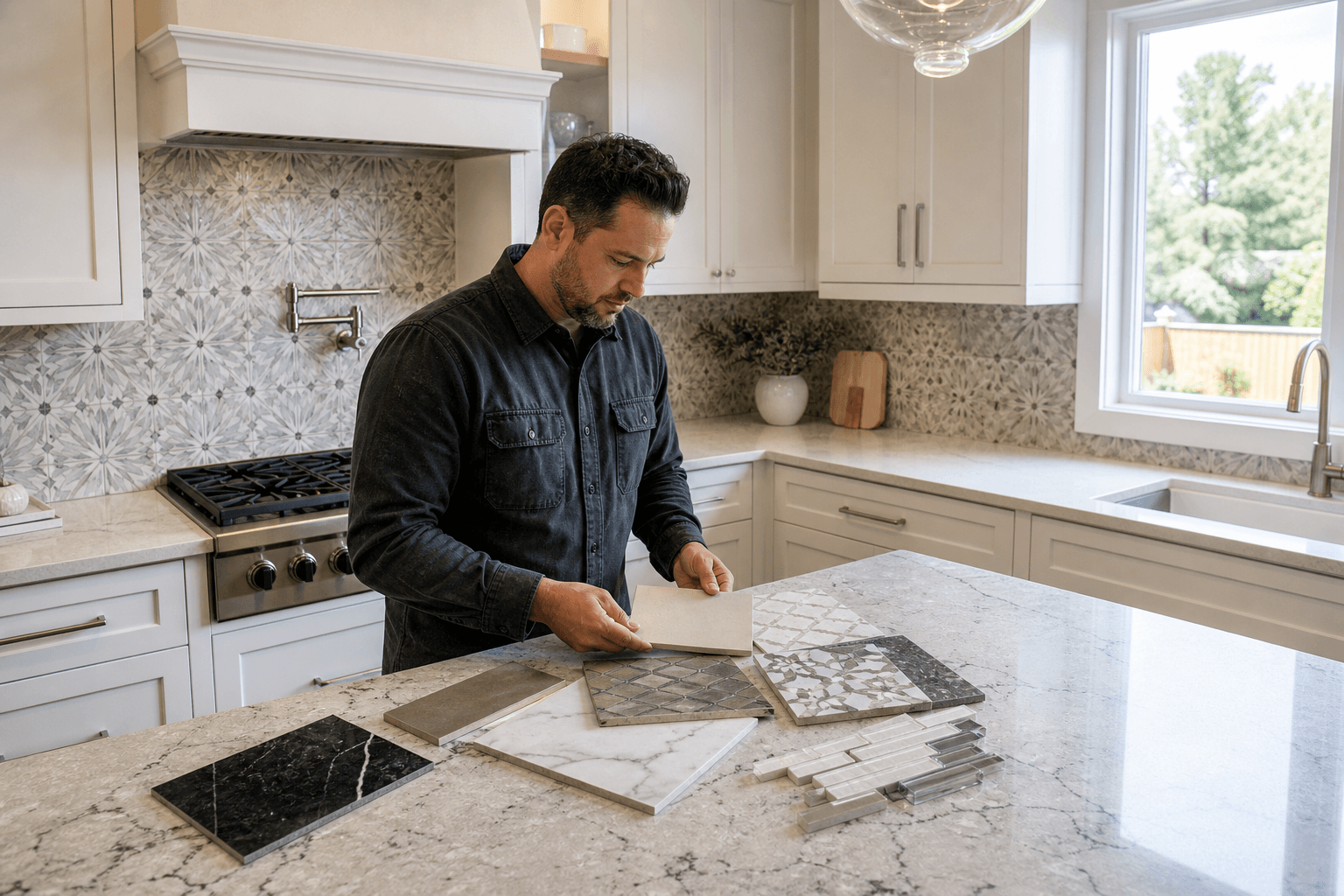
There is no single best backsplash material for every kitchen. The right choice depends on the look you want, how much cleaning and grout care you will accept, how the surface will handle daily cooking, and how complex the installation will be.
This backsplash materials comparison covers ceramic, porcelain, glass, natural stone, slab surfaces, and metal using the same practical criteria. It also explains how your selection affects cabinetry, countertops, outlets, appliances, wall preparation, and the wider renovation schedule.
Backsplash materials compared at a glance
These are relative comparisons rather than fixed prices. The final cost depends on the material, area, pattern, cuts, wall condition, installation method, fabrication, and coordination with other kitchen work.
| Material | Visual effect | Durability and cleaning | Repairs and joints | Installation position |
|---|---|---|---|---|
| Ceramic | Many colours, shapes, patterns, and textures | Practical for walls with routine cleaning | Visible grout; individual tiles can often be replaced | Flexible format and generally accessible installation |
| Porcelain | Tile flexibility with stone-like and other finishes | Durable, water repellent, and resistant to chips and scratches according to tile material guidance | Grout remains part of maintenance; localized repair is possible | Performance-focused, with complexity affected by format and cuts |
| Glass | Reflective, bright, smooth, textured, or colour-led | Can provide a smooth surface; marks vary by finish | Matching and cutting require care | Needs product-specific materials and precise handling |
| Natural stone | Distinctive variation, veining, and texture | Care depends on the exact stone and finish | Pattern matching and replacement can be more involved | Layout and handling can increase complexity |
| Slab | Continuous appearance with fewer joints | Fewer joints, but suitable care is still required | Local repair is less straightforward than tile replacement | Templating, fabrication, weight, and outlet cuts add complexity |
| Metal | Contemporary, commercial, or industrial depending on finish | Cleaning expectations vary by texture and finish | Edges, seams, and visible marks need planning | Format and finish strongly influence installation |
Ceramic and porcelain: flexible tile options

Ceramic and porcelain are versatile wall tile categories, but they are not identical. Ceramic offers extensive choice in colour, shape, texture, and pattern, making it useful when you want character without committing to a continuous slab.
Porcelain is often considered when durability and low maintenance are higher priorities. The cited guidance describes porcelain as water repellent and resistant to chips and scratches, while ceramic and porcelain are suitable for wall applications with low maintenance requirements. Confirm the specifications for the exact product, since not every tile has the same characteristics.
Tile also provides practical repair flexibility. If matching material is available, an individual damaged tile can usually be replaced without removing the entire backsplash. The tradeoff is that grout lines remain part of the visual design and cleaning routine.
Glass: reflective and design-led
Glass can make a kitchen feel brighter and more visually open because of its reflective quality. Smooth or textured formats can add colour, depth, and light-catching detail, as reflected in Canadian backsplash material guidance.
Its visual strengths make planning important. Consider how light will fall across the surface, whether cooking marks will be prominent, how edges will be finished, and how outlets and corners will be cut. Glass tiles also require an appropriate mortar and installation method. The product guidance from backsplash installation instructions notes that glass tiles require thin-set mortar.
Natural stone: distinctive variation with more upkeep considerations
Natural stone is a design choice as much as a material choice. Its variation, veining, and texture can become a focal point, especially when the rest of the kitchen uses restrained colours and simple lines.
Look closely at the exact stone, finish, tile size, and layout before committing. Variation can make replacement matching difficult, while smaller formats introduce more joints. Stone tile may also require more deliberate cleaning and maintenance decisions than a smooth, uniform surface. For heavily patterned stone, request a layout plan or sample arrangement.
Slab surfaces: a continuous look with greater fabrication complexity
A slab backsplash uses a large piece of stone or another slab material rather than individual tiles. Its main visual advantage is continuity: fewer joints can create a calmer surface and connect the backsplash visually to the countertop.
The cleaner appearance comes with more involved fabrication and handling. The slab must be templated, transported, positioned, and cut accurately around outlets and other penetrations. It can also be heavy, and lead times may depend on fabrication. Compared with tile, a damaged section is generally less straightforward to replace, as explained in this comparison of stone slabs and tiled backsplashes.
Metal: a specific look for the right kitchen
Metal backsplashes come in different finishes, sizes, and formats. They can support a contemporary or commercial-style kitchen, but they are not a default solution for every room. Finish, texture, cabinetry, countertop, and lighting determine whether the result feels deliberate.
Consider fingerprints, splashes, cleaning marks, seams, corners, and exposed edges in daily use. Ask how the metal will be cut and finished around outlets, and whether its sheen works with the room’s other hardware.
How to choose by the criteria that matter
Budget position
Material price is only one part of the decision. Labour, wall preparation, layout complexity, cuts, grout or seams, fabrication, disposal, and coordination with cabinets and countertops can change the total. A simple tile pattern may be easier to install than a large-format or highly detailed layout, while a slab may require more fabrication even when its surface looks simple.
Because finish choices affect labour, lead times, and installation complexity, review the kitchen renovation cost drivers before choosing. Online price ranges should be treated as indicative, not as a project quote.
Durability and cooking conditions
For a busy kitchen, consider splashes, heat exposure in the selected location, cleaning frequency, and accidental impact. Porcelain is a strong candidate when durable, low-maintenance tile performance is important. Ceramic can also be practical when the specific product and installation are suitable.
Glass, stone, slab, and metal should be judged by their exact finish and installation details rather than by category alone. Whichever backsplash you select, prioritize finish quality and durable finish systems.
Cleaning, grout, and seams
Tiles provide flexibility but introduce grout lines. Slabs reduce joints but require accurate fabrication and may be harder to repair locally. Glass can offer a smooth visual field, while textured surfaces and heavily varied stone may need more attention during cleaning. Metal requires a finish-specific discussion about marks and cleaning products.
Repairability
If easy future repair is important, tile generally gives you more localized options than a slab. Keep spare tiles or record the product name and batch information. With glass, natural stone, and metal, matching colour, texture, sheen, and pattern can be difficult after the original product is discontinued.
Match the backsplash to the rest of the kitchen
Do not select the backsplash independently from the countertop and cabinetry. Wall dimensions, countertop thickness, cabinet height, appliance placement, outlet positions, lighting, and the intended stopping point all affect the layout. A sample may look excellent but need a different pattern direction or edge treatment once it meets cabinets, windows, and outlets.
For a coordinated kitchen upgrade, plan backsplash and countertop installation alongside cabinetry, electrical work, and other finish details. This is particularly important for slabs, large-format tile, visible outlet cuts, and designs that rely on continuous lines.
Installation details that affect the finished result
Confirm wall condition before approving the material. Uneven surfaces, old adhesive, damaged drywall, and unplanned penetrations can affect preparation and layout. The installation scope should identify demolition, disposal, patching, levelling, material-specific mortar, grout, caulking, trim, outlet cuts, and final cleaning.
Sequencing matters. Cabinet and countertop dimensions, outlet locations, and appliance clearances should be known before final cuts are made. A contractor coordinating several trades can use the address, scope, and deadline to plan the work, price the project, and clarify where the backsplash fits in the renovation.
A practical decision path for homeowners
- Choose ceramic for broad design flexibility and practical tile repair.
- Choose porcelain for durability, water resistance, and low-maintenance performance.
- Choose glass for reflectivity, colour, and visual impact.
- Choose natural stone when distinctive variation is central to the design.
- Choose a slab when fewer joints justify templating and fabrication complexity.
- Choose metal when its finish suits the kitchen and its cleaning and edge requirements are clear.
Backsplash installation quote checklist
- Wall dimensions, backsplash height, and stopping points.
- Material, format, colour, finish, and pattern direction.
- Countertop material, thickness, edge profile, and installation status.
- Cabinet dimensions, appliances, windows, switches, and outlets.
- Grout colour, joint size, seams, trim, and exposed-edge treatment.
- Wall preparation, demolition, disposal, patching, and protection.
- Who supplies the material, mortar, grout, trim, and fabricated pieces.
- How work will be sequenced with cabinetry, countertops, electrical work, and other trades.
Frequently asked questions
Is porcelain better than ceramic for a kitchen backsplash?
Not universally. Porcelain suits durability and low-maintenance priorities, while ceramic may offer the design or budget position that better fits your kitchen. Compare the exact product and installation requirements.
Are slab backsplashes easier to maintain than tiled backsplashes?
A slab has fewer joints and can create a simpler continuous surface, but it involves more fabrication and may be harder to repair locally. Tile requires grout care but offers more flexibility.
Which backsplash material is easiest to repair?
Individual tile formats generally offer the most straightforward localized repair, provided matching material is available. Slabs, glass, stone, and metal may require a larger replacement section.
Should the backsplash be chosen before the countertop and cabinets are installed?
Choose the material and general layout early enough to coordinate the countertop, cabinetry, outlets, and appliances. Confirm final measurements against installed or accurately templated components.
What should be included in a backsplash installation quote?
The quote should identify material, quantity, layout, cuts, wall preparation, demolition, disposal, mortar, grout, trim, outlet work, seams, edge details, protection, and trade coordination.
Conclusion: choose the material that fits the whole renovation
The best backsplash balances appearance with daily maintenance, durability, repair expectations, installation complexity, and the rest of the kitchen design. Tile is flexible, porcelain suits performance-led decisions, glass creates reflectivity, stone adds variation, slabs provide continuity, and metal delivers a more specific visual character.
Before approving a material, confirm wall dimensions, outlet cuts, grout or seam plans, countertop and cabinet interfaces, and installation scope. Deeroi Constructions provides kitchen renovations, backsplash and countertop installation, pricing, planning, and trade coordination across the GTA and Ontario. To discuss your address, scope, and deadline, contact Deeroi Constructions.